India's Sugar Crisis: What Your Family Needs to Know Before It's Too Late
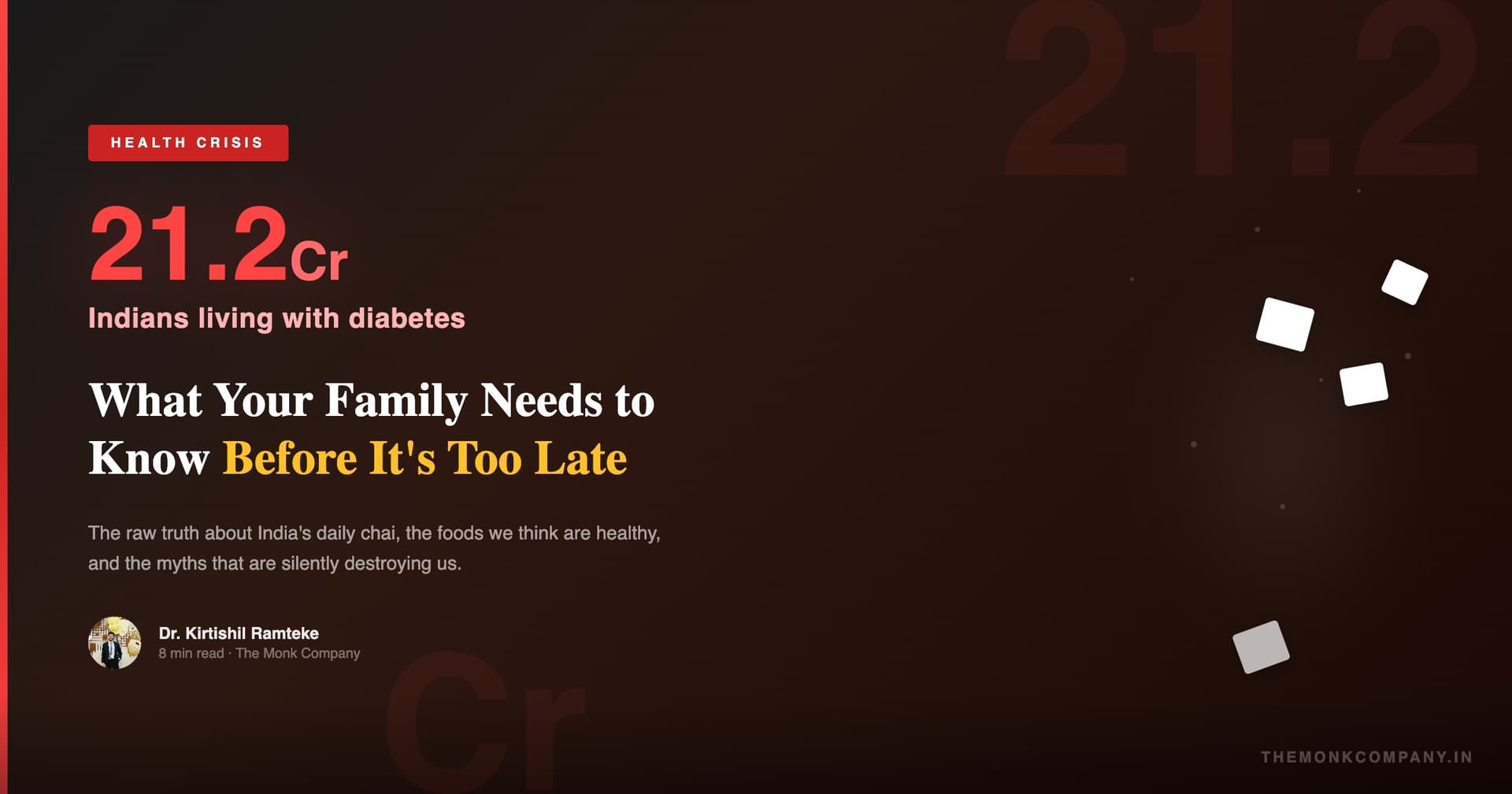
21.2 crore Indians have diabetes. More than half don't know it yet. A raw, honest look at how our daily chai, the foods we think are healthy, and the myths we believe are silently destroying Indian families, and what you can actually do about it.
I still remember the day clearly. Papa came back from the doctor, sat down on the sofa, and just stared at the wall for a long time. Mummy asked him what happened. He said, "Sugar hai."
Type 2 diabetes. At 48. He wasn't overweight. He walked every morning. He was the "healthy one" in the family.
But nobody counted the three cups of chai a day, two spoons each. The Parle-G with the evening cup. Mithai at festivals. It was just... life.
I'm writing this because I don't want what happened to my father to happen to yours.
The Numbers Are Staggering
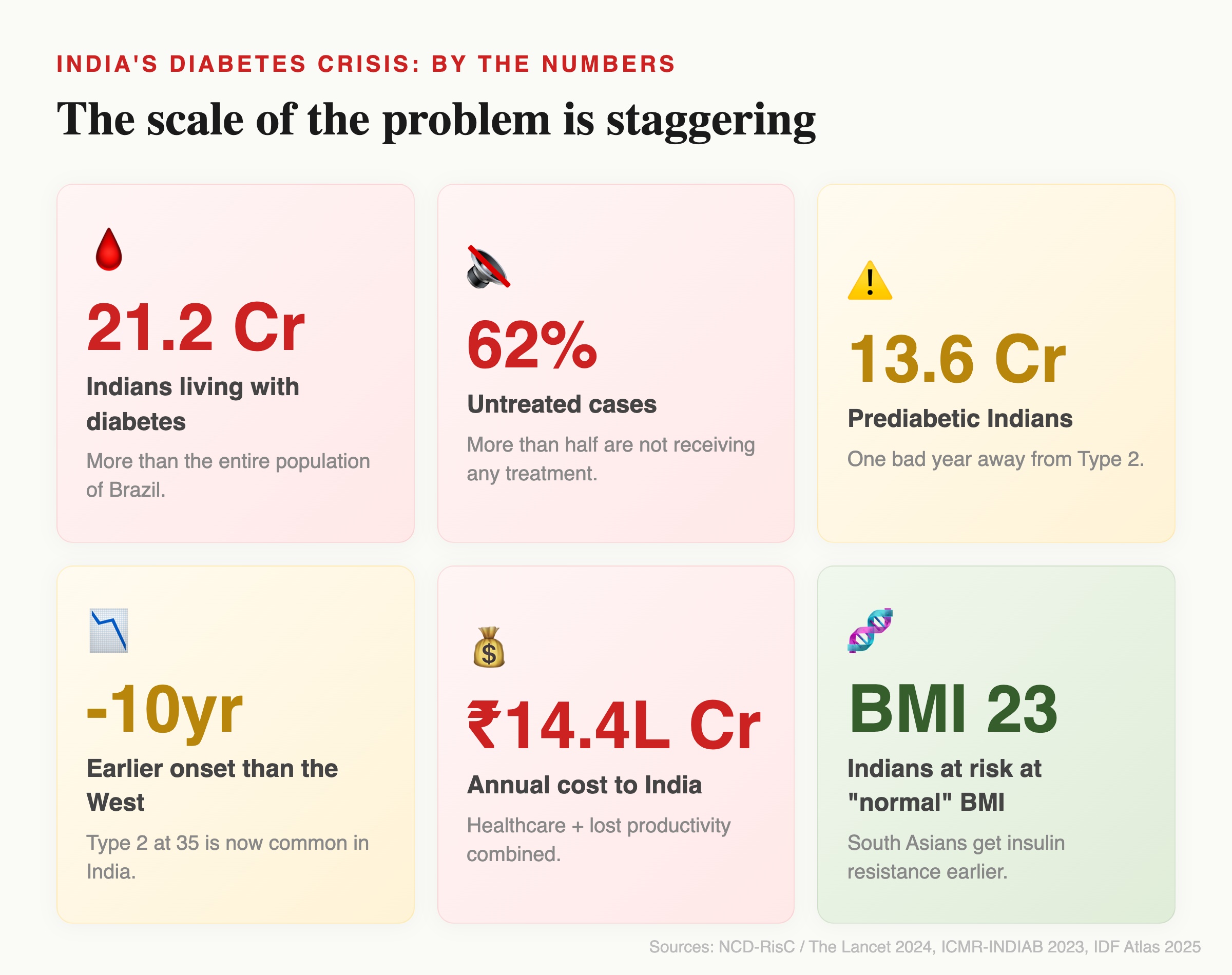
21.2 crore Indians have diabetes. More than half don't even know. Another 13.6 crore are prediabetic, one bad year away from crossing over.
I see it every day. The 38-year-old IT guy who came for a routine checkup and left with a diagnosis. The 45-year-old mother who found out because her wound wouldn't heal. This isn't a "someday" problem. It's happening right now, in your family, probably already.
Where the Sugar Is Hiding
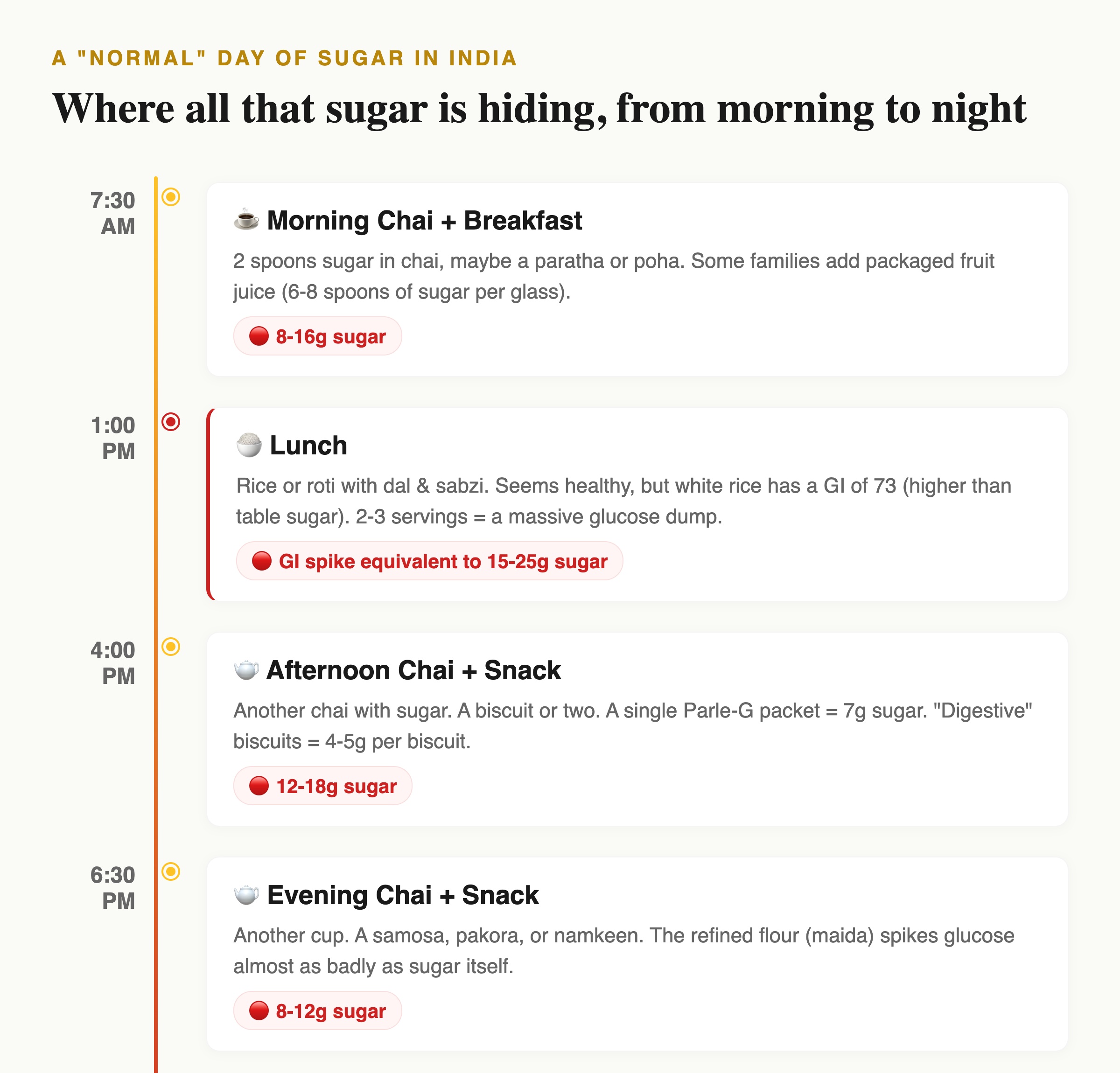
A typical Indian day: chai with sugar at 7:30 AM (kids get "fruit" juice, which is basically Coke in a box). White rice at lunch (GI of 73, higher than table sugar). Chai + biscuits at 4 PM. Samosa at 6:30. More roti and something sweet after dinner.
Total: 50-80 grams of sugar daily. The WHO says max 25. And that's before counting the hidden sugar in ketchup, "atta" bread, Bournvita, and those "healthy" protein bars.
What Sugar Actually Does to Your Body
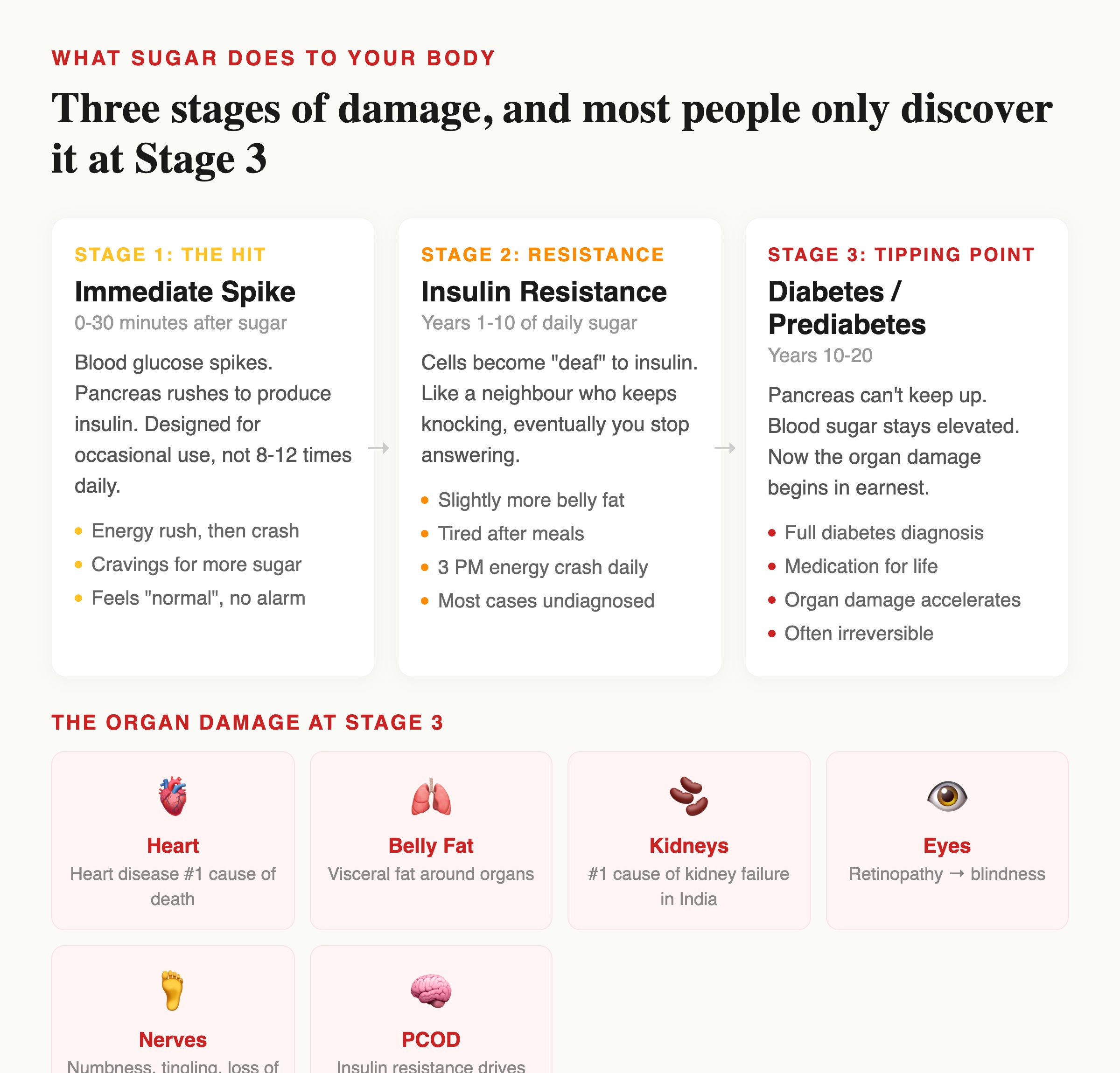
Your body was designed to handle sugar sometimes. Not 8-12 times every day for 30 years. When your pancreas pumps insulin that often, your cells stop listening. That's insulin resistance. The cruel part? You feel totally fine. Maybe a bit tired after lunch, maybe that stubborn belly fat. But nothing that says "go to a doctor."
By the time it shows up as diabetes, the damage has already started: visceral fat around organs, fatty liver (30-40% of urban Indians have it), PCOD, nerve damage, kidney failure. Diabetes is the #1 cause of kidney failure in India.
The "Healthy" Foods That Aren't
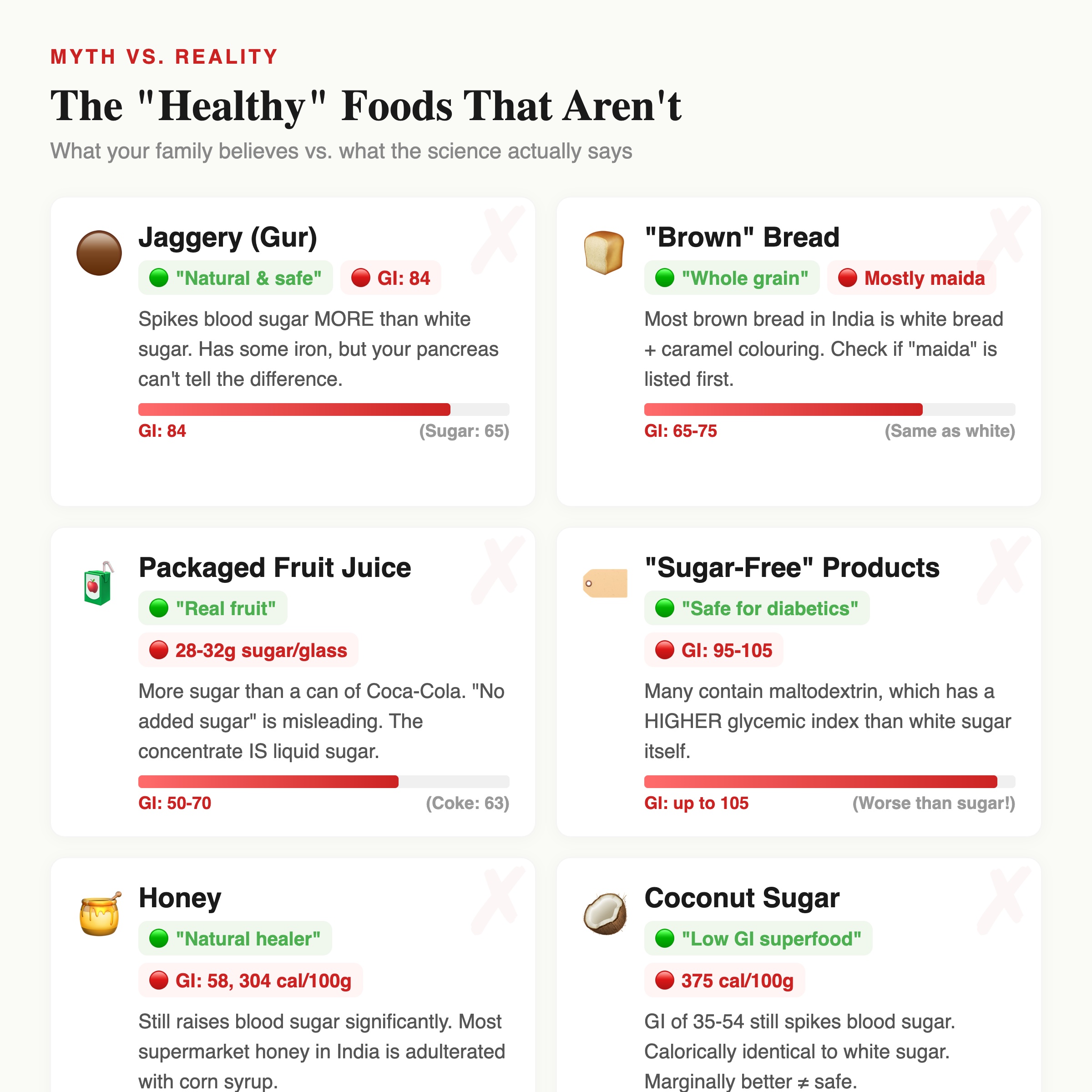
Jaggery: GI of 84, actually higher than white sugar (65). Your pancreas doesn't care that it's "natural."
"Brown" bread: Check the ingredients. If maida is listed first, it's white bread with brown colouring.
Packaged juice: A glass of Real Mango has 28-32g of sugar. A Coke has 35g. You're giving your child a Coke and calling it breakfast.
"Sugar-free" products: Many use maltodextrin (GI of 95-105). That's HIGHER than sugar. "Sugar-free" is sometimes literally worse.
Honey: Even real honey (GI 58) still spikes your sugar. And CSE found most Indian brands are adulterated with corn syrup.
The Chai Math
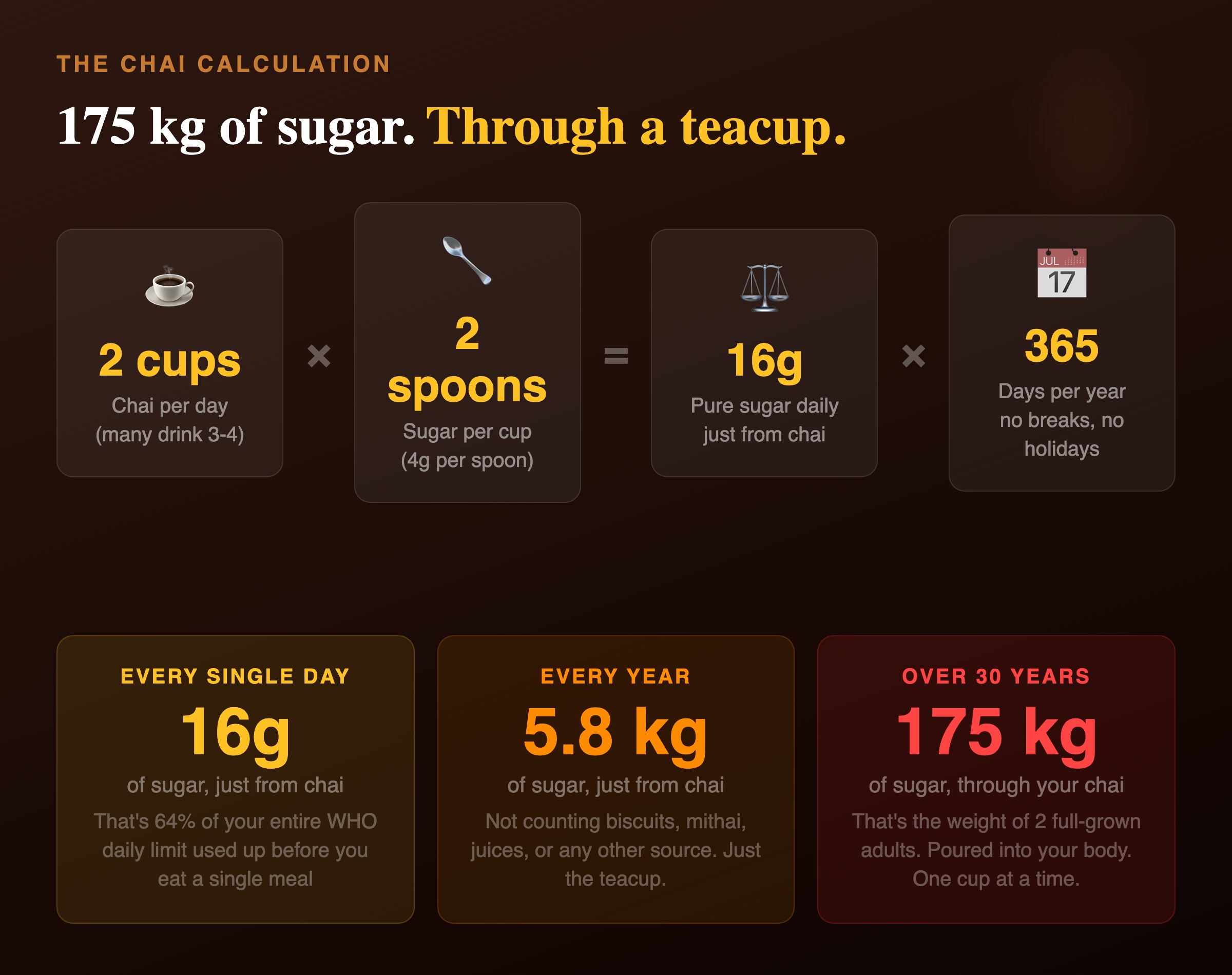
2 cups a day. 2 spoons each. That's 16 grams of sugar daily just from chai. Over 30 years: 175 kg of sugar through a teacup. That's the weight of two grown men.
Add the biscuits, mithai at Diwali, Frooti on a hot afternoon, and that "one small piece" every aunty insists you take. Nobody's bingeing. It's just Tuesday in any Indian household. That's what makes it so dangerous. It's so normal you can't even see it.
Why Indians Specifically?
South Asians develop insulin resistance at a lower BMI than other populations. An Indian at BMI 23 ("normal") can have the same metabolic damage as a European at BMI 30. You don't have to be overweight to be at risk. My father was thin. He walked every day. He still got diabetes.
Our genes loaded the gun. Our diet pulls the trigger. Every day. With chai.
What This Costs Your Family (In Rupees)
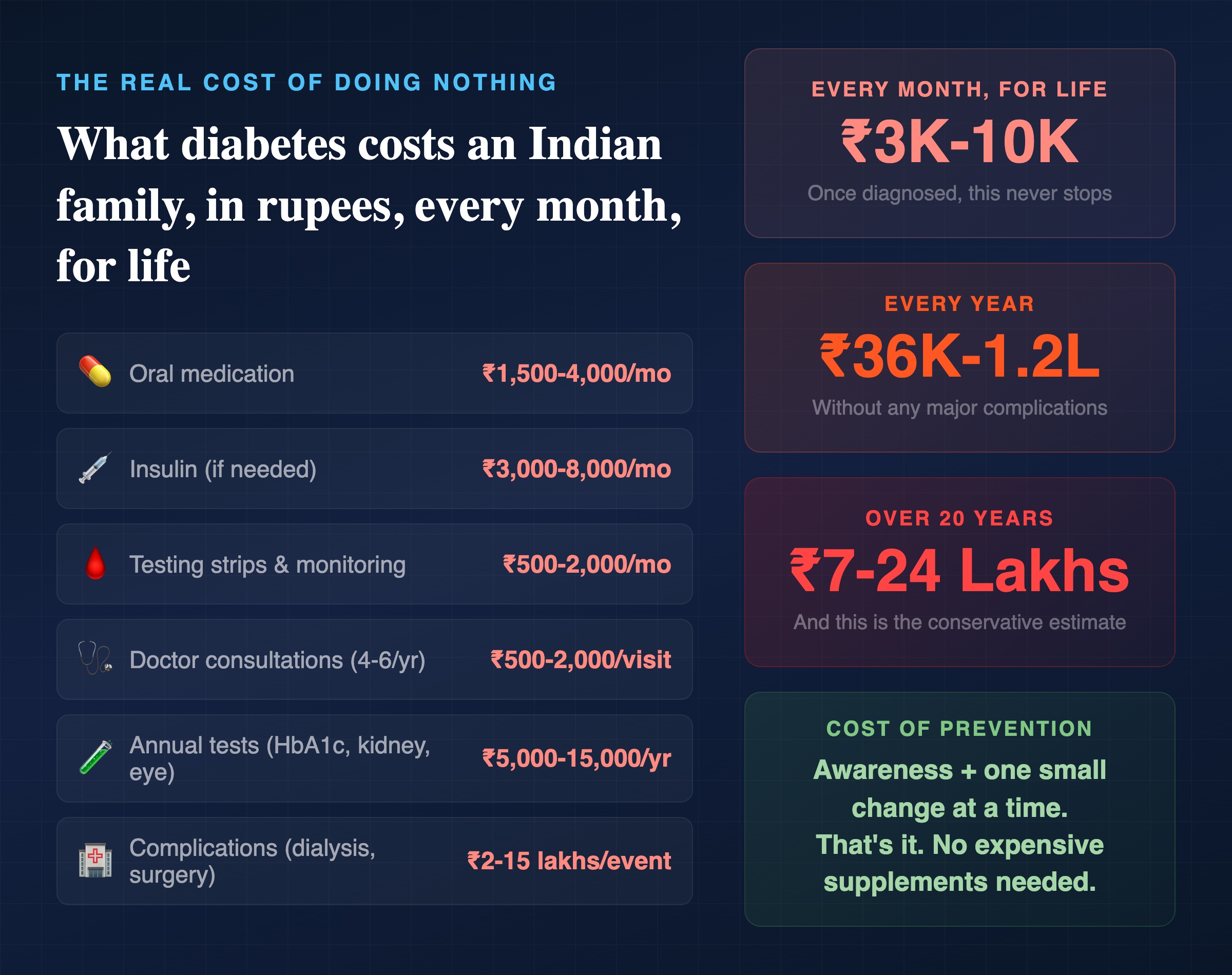
Once you're diagnosed: medicines ₹1,500-4,000/month, insulin ₹3,000-8,000/month, testing ₹500-2,000/month, doctor visits, annual blood work. If complications hit (dialysis, cardiac stent, retinal surgery): ₹2-15 lakhs per event.
₹3,000-10,000 every month. For life. That's ₹7-24 lakhs over 20 years. I've had patients sell property for dialysis. Pull kids out of better schools because medical bills ate the education fund.
Prevention costs? Awareness. Small changes. That's it.
6 Things You Can Do, Starting Today
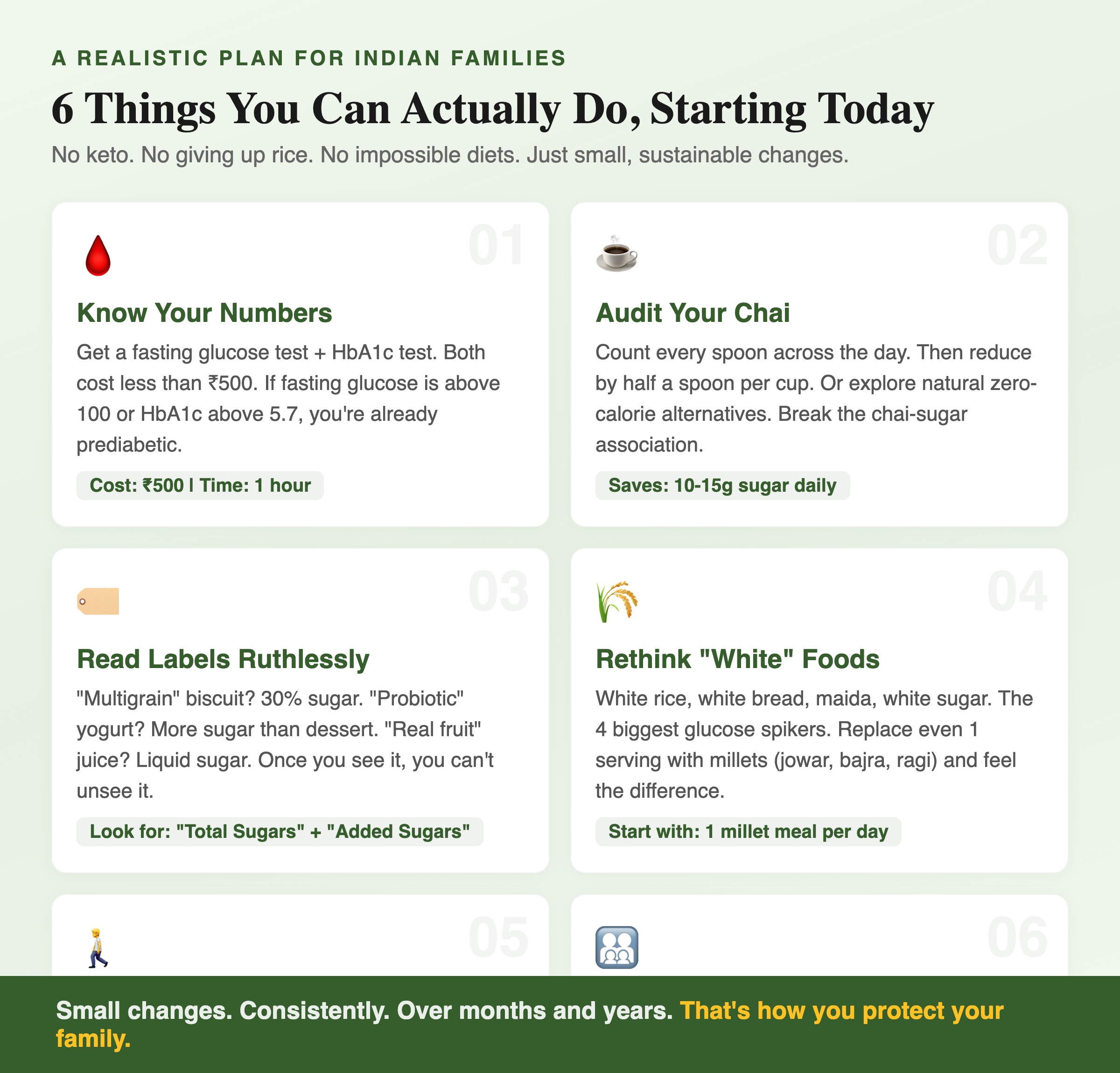
No keto. No giving up rice. No impossible diets. Just this:
1. Get tested. Fasting glucose + HbA1c. Under ₹500. If fasting glucose is above 100 or HbA1c above 5.7, you're already prediabetic. Go this week.
2. Count your chai sugar. Just count for one day. Then reduce by half a spoon per cup. You won't even notice.
3. Flip the packet over. Look at "Total Sugars." That "digestive" biscuit has more sugar than a chocolate one. Once you start looking, you can't stop.
4. One millet swap. Ragi roti instead of wheat roti, once a day. Way lower blood sugar spike. Try it for two weeks.
5. Walk 15 minutes after dinner. Not a run, not gym. Just a walk. It cuts your post-meal sugar spike by a lot. Free. Every day.
6. Talk to your family. Show them this article if you can't find the words. In Indian homes, we eat together. We should decide to be healthy together too.
To Whoever Makes the Chai
You are the most important healthcare worker in your family. More than any doctor. Because health isn't built in a clinic. It's built in the kitchen. Every morning.
Change one thing this week. One less spoon of sugar. Makhana instead of Marie biscuit. Nimbu pani instead of Frooti. Small things, done consistently, by someone who cares. That's the difference between a family that becomes a statistic and one that doesn't.
My father has been managing his diabetes for years now. He's okay. But "okay" isn't great. What if someone had shown him an article like this 20 years ago?
You're reading this now. You know. The question is: what is your family going to do about it?
Start with your next cup of chai.

MBBS, Health & Wellness Writer
References & Sources
Every number in this article comes from peer-reviewed research or government data. Here are the sources so you can verify (and share with that skeptical uncle):
- 21.2 crore Indians with diabetes - NCD Risk Factor Collaboration (NCD-RisC) & WHO. "Worldwide trends in diabetes prevalence and treatment from 1990 to 2022." The Lancet, 2024. Read on The Lancet
- 10.1 crore diabetics + 13.6 crore prediabetics in India - Anjana RM et al. "Metabolic non-communicable disease health report of India: the ICMR-INDIAB national cross-sectional study." The Lancet Diabetes & Endocrinology, 2023. Read on The Lancet
- IDF Diabetes Atlas, India data - International Diabetes Federation. IDF Diabetes Atlas, 11th Edition, 2025. View India data on IDF Atlas
- WHO sugar intake guideline (25g/day) - World Health Organization. "Guideline: Sugars intake for adults and children," 2015. Read WHO guideline
- Jaggery glycemic index (84) vs sugar (65) - National Institute of Nutrition, India. "Glycaemic indices of different sugars." Proceedings of the Nutrition Society of India, 1987. Also: Magna Scientia Advanced Research and Reviews, 2025. Read the review
- White rice glycemic index (70-80) - Harvard Health Publishing. "A good guide to good carbs: The glycemic index." Also: Vemireddy LR et al. "Insights into recent updates on factors and technologies that modulate the glycemic index of rice." Foods, 2023. Read on PubMed Central
- Honey adulteration in India - Centre for Science and Environment (CSE). "Investigation: Business of adulteration of honey," 2020. Read CSE report
- South Asians & insulin resistance at lower BMI - Caleyachetty R et al. "Ethnicity-specific BMI cutoffs for obesity based on type 2 diabetes risk." The Lancet Diabetes & Endocrinology, 2021. Also: Kanaya AM et al. "Diabetes in South Asians." Diabetes Care, 2024. Read on The Lancet
- Post-meal walking reduces blood sugar spikes - Bellini A et al. "After dinner rest a while, after supper walk a mile? A systematic review with meta-analysis." Sports Medicine, 2023. Also: DiPietro L et al. "Three 15-min bouts of moderate postmeal walking." Diabetes Care, 2013. Read the meta-analysis
- Fatty liver (NAFLD) prevalence in India, 38-40% - Duseja A et al. "Prevalence of non-alcoholic fatty liver disease in India: A systematic review and meta-analysis." Journal of Clinical and Experimental Hepatology, 2022. Read on PubMed Central
- Diabetes as leading cause of kidney failure in India - Jha V. "Chronic kidney disease and its prevention in India." Kidney International. Also: CITE Study, BMC Nephrology, 2025. Read on PubMed Central
- India's tea consumption data - Tea Board of India. "Executive Summary: Pilot study on domestic consumption of tea in India." Read Tea Board report (PDF)
This article is for educational purposes only and does not constitute medical advice. Please consult your physician before making any changes to your diet or lifestyle. Data cited is the most recent available at the time of writing.